
A 6.9-point difference does not choose a solution
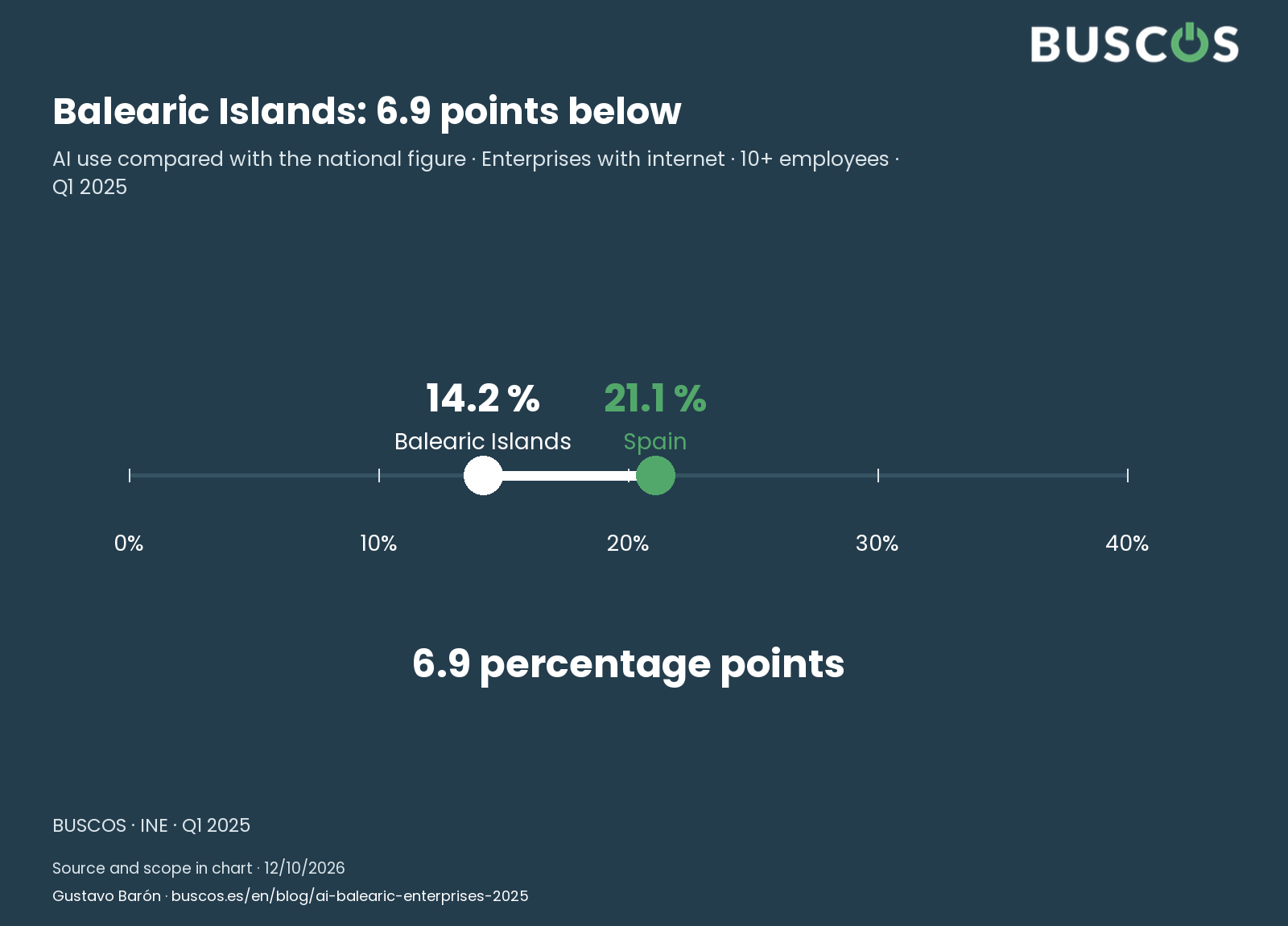
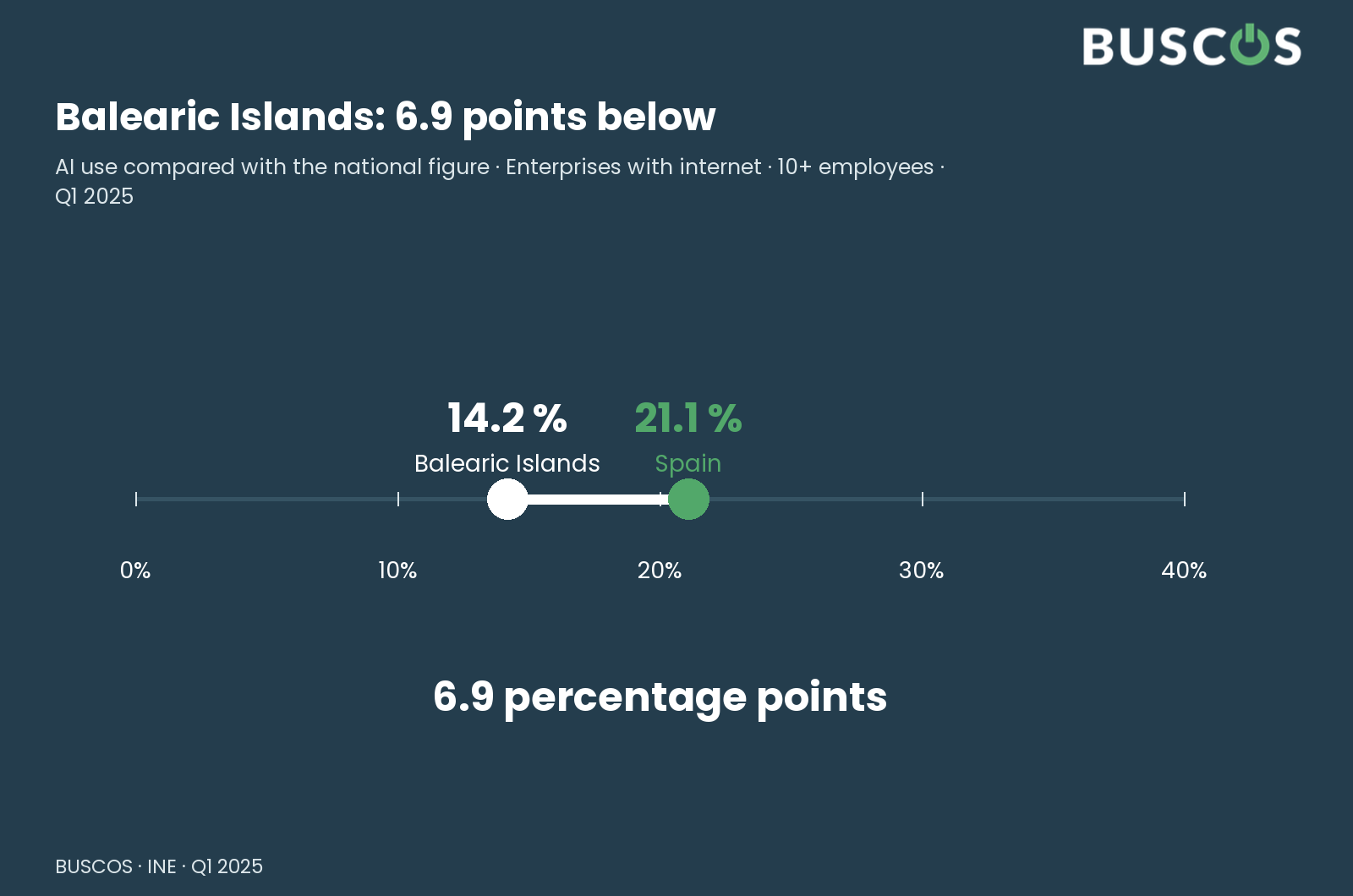
INE records 14.2% of enterprises using AI in the Balearics, against a national benchmark of 21.1%. The difference is 6.9 percentage points within the regional table for the first quarter of 2025. That precisely describes the distance. It does not mean Balearic businesses are 6.9% less productive.
The statistic covers enterprises with ten or more employees, an Internet connection and activity in the included sectors. Territory follows registered headquarters. It does not describe every small business on the islands or provide separate rates for Mallorca, Menorca, Ibiza and Formentera. Nor does this table separate each economic activity within the Balearics.
The finding deserves attention because reported use is below the national benchmark. But a business does not need to match an average to justify a project. It needs to understand what work could improve, what information is required and what change would be useful to check. The statistic provides context; it does not select a tool.
The distance differs across technologies
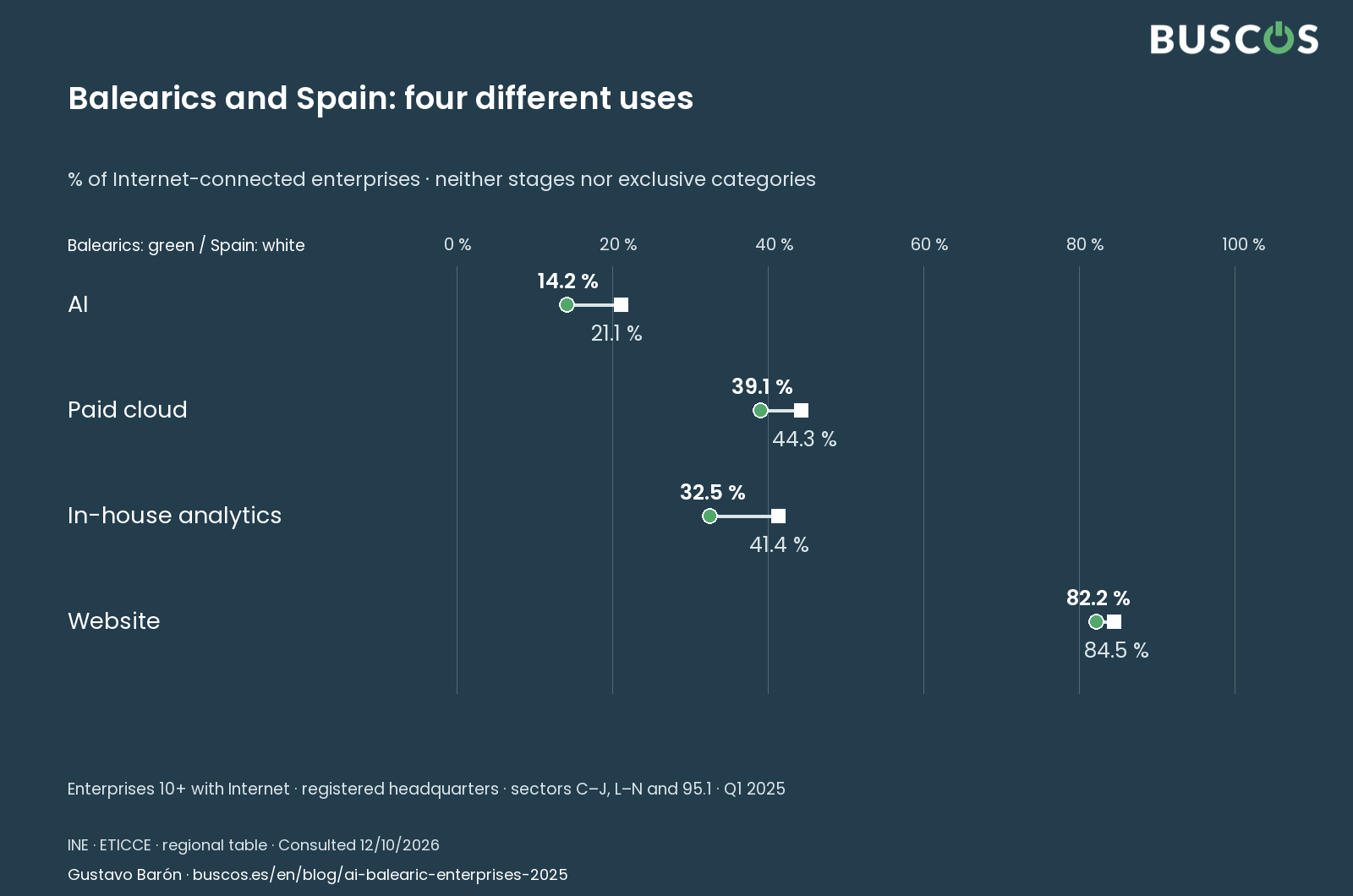
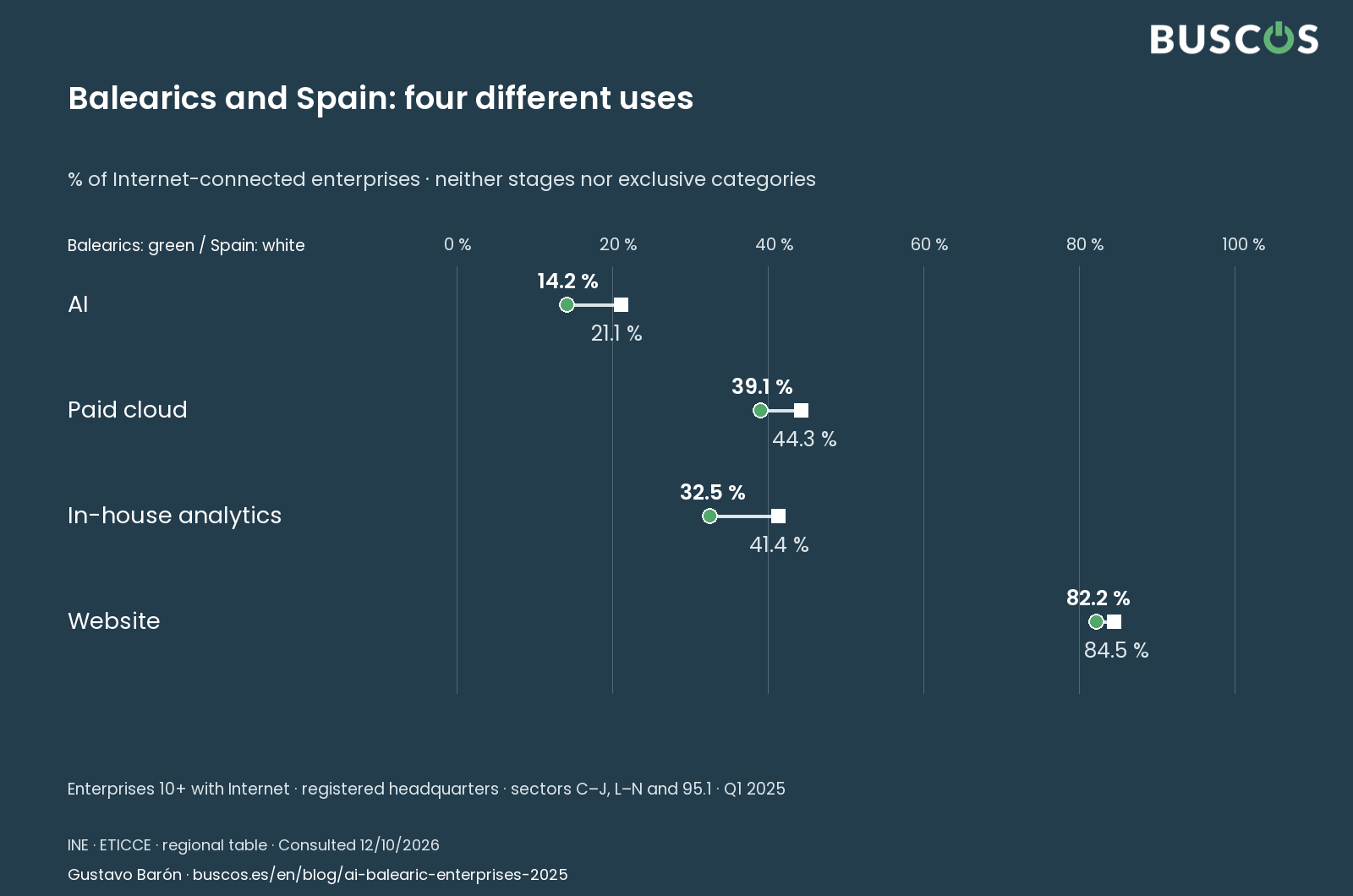
INE's table allows a broader reading. Within this scope, 39.1% of Balearic enterprises use paid cloud computing and 32.5% perform data analytics through their own employees. The national benchmarks are 44.3% and 41.4%. Website presence reaches 82.2% in the Balearics and 84.5% nationally.
These comparisons share the regional table's scope of Internet-connected enterprises, but measure different uses. The difference is 2.3 points for websites, 5.2 for cloud services, 8.9 for analytics and 6.9 for AI. Reading them together shows that there is no single digital distance applicable to every task.
The percentages are not successive steps on a staircase. One business can have a website, buy cloud services and use AI at the same time; the table does not reveal individual combinations. Nor does every business have to pass through the same technologies. The profile raises questions about information and work rather than providing a universal implementation recipe.
| Indicator | Balearics | Spain | Difference in percentage points |
|---|---|---|---|
| AI | 14.2 % | 21.1 % | -6.9 |
| Paid cloud | 39.1 % | 44.3 % | -5.2 |
| In-house analytics | 32.5 % | 41.4 % | -8.9 |
| Website | 82.2 % | 84.5 % | -2.3 |
Enterprises 10+ with Internet. Different, non-exclusive indicators. Each difference is Balearics minus Spain.
Comparing with the Canaries and Catalonia requires the same question
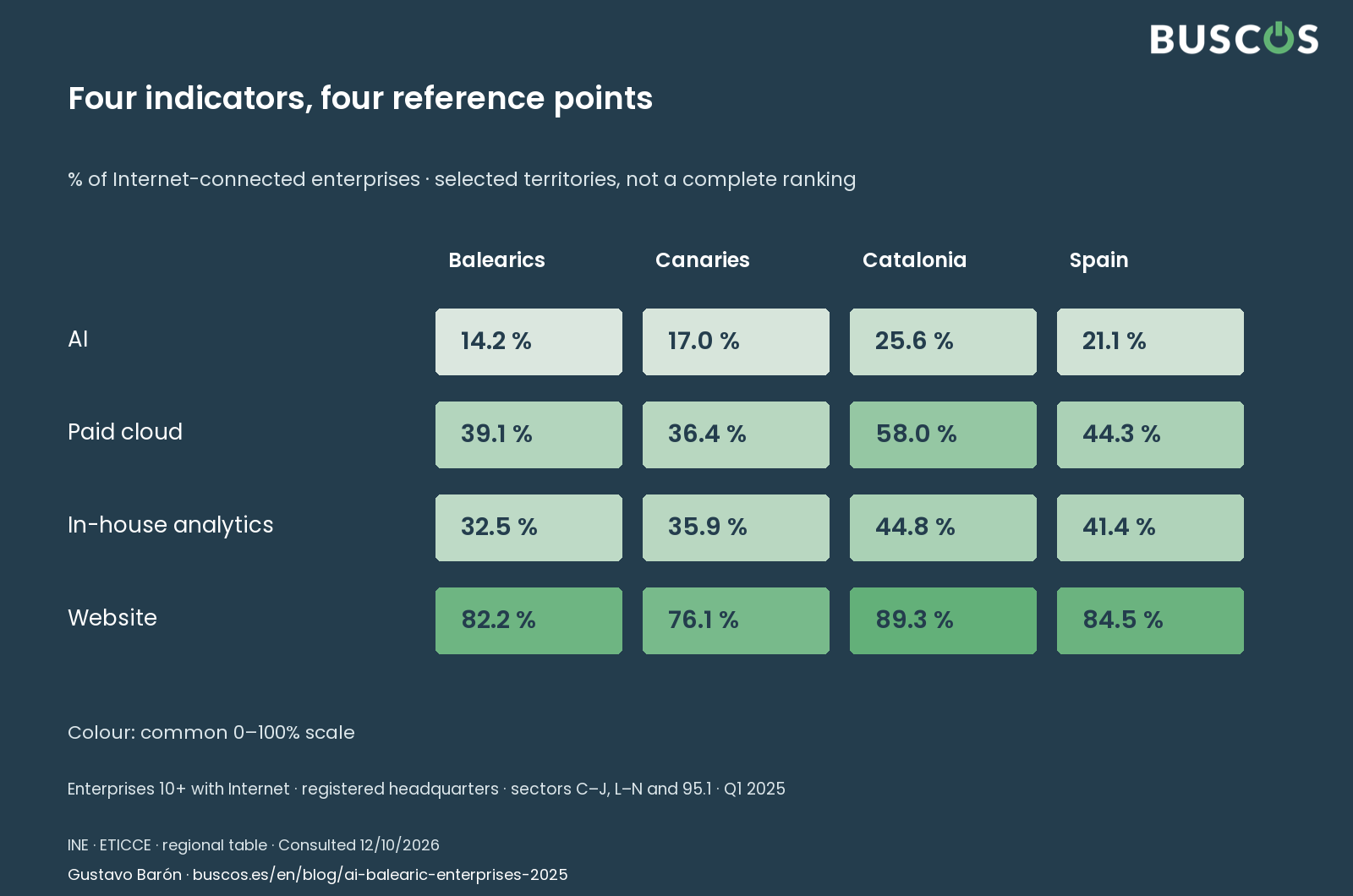
The Canaries record 17.0% and Catalonia 25.6% AI use in the same table. Alongside the Balearics and the national benchmark, these figures offer a compact comparison of selected territories. This is neither a complete ranking nor a tourism-specific comparison: it includes the activities covered by the survey in each territory.
The Balearics and the Canaries are both island regions, but that does not make the chart an explanation of island geography. These percentages do not show how business size, activity or organisation contribute to the difference. The chart cannot attribute it to a single characteristic.
The regional statistic does not distinguish occasional uses from uses embedded in a process either. Two businesses can report AI while having very different maintenance, learning and review needs. Deciding on a specific assignment requires moving from territorial comparison to what happens inside the company.
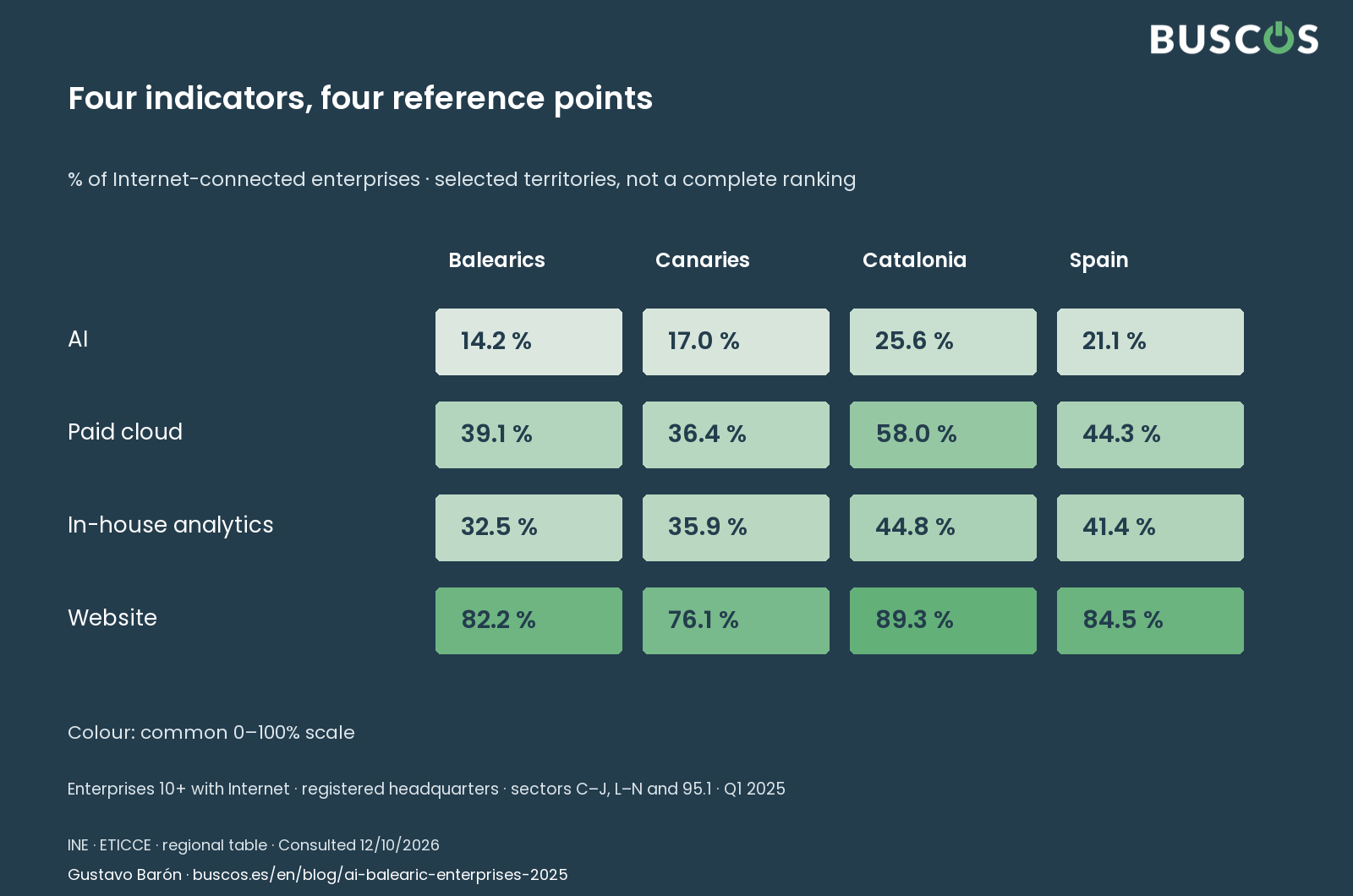
| Territory | AI | Paid cloud | In-house analytics | Website |
|---|---|---|---|---|
| Balearics | 14.2 % | 39.1 % | 32.5 % | 82.2 % |
| Canaries | 17.0 % | 36.4 % | 35.9 % | 76.1 % |
| Catalonia | 25.6 % | 58.0 % | 44.8 % | 89.3 % |
| Spain | 21.1 % | 44.3 % | 41.4 % | 84.5 % |
Not a complete ranking or a tourism comparison. The source does not separate islands or sectors within the Balearics.
An everyday task provides a more useful starting point
Think of a business receiving bookings, enquiries or orders by email and checking them against information held elsewhere. Before discussing AI, follow one request from arrival to resolution: what gets searched, copied and checked, and who responds when something is missing. This example describes neither an implementation nor an observed client saving.
Time might be spent finding the current version of a document. Exceptions might require someone who understands the process. Or the team might already have the information and need to learn how to use it better. Those situations call for different responses, even if they initially appear as one need for AI.
A good description includes difficult cases too: a reference that does not exist, contradictory information or a request requiring authorisation. These cases help check whether a proposal understands the work instead of merely producing a convincing response in a demonstration.
If work varies by season, check those differences
When demand changes across the year, a test performed only during a quiet period can leave questions unanswered. If teams, languages, suppliers or volumes change, reviewing examples of those conditions is worthwhile. We do not attribute this situation to every Balearic business: it is a question for those who recognise it in their own activity.
A proposal should explain what information must be available, who will update references and who will check exceptions. It should also explain what happens when information is insufficient. A repeatedly used system needs clear responsibilities and conditions, not just one correct initial response.
The review may suggest learning something internally, defining the assignment more carefully or obtaining specialist help. The choice depends on the work and on what can be checked. The regional percentage does not demonstrate a need to hire or guarantee that any implementation will be profitable.
The Canaries change position when the indicator changes
Comparing with the Canaries reveals more than AI use. The Balearics are lower in AI but higher in paid cloud computing: 39.1% against 36.4%. Analytics performed by the business's own employees reaches 32.5% in the Balearics and 35.9% in the Canaries. Positions differ by indicator within the same table.
Catalonia records higher percentages than both regions for these three uses. This adds context without turning its profile into a recipe every Balearic business should reproduce. The chart compares regional proportions, not the providers, integrations or outcomes of the businesses behind them.
For a business already using cloud services, the conversation may concern the information they contain and the work needing resolution. For another, it may begin with organising references or clarifying who can use them. Knowing a company's region cannot identify its situation. The four technologies are therefore shown as separate indicators.
The goal is a recognisable improvement, not reaching 21.1%
The contrast between the Balearics and Spain provides serious context for a conversation. The cloud, analytics and website profile makes it more complete. Still, none of these percentages answers for an individual business. An average knows nothing about its documents, people or decisions that must remain checked.
The next step can be small: choose one situation, explain how it works today and identify what would improve it. If a proposal already exists, examine what it promises, what it needs and how it would be validated. If a solution must be commissioned, describe the responsibilities and specialism the work requires.
That precision makes the AI conversation useful without buying through fear of falling behind. The figure helps direct attention. The decision begins when the business can describe a problem it recognises and what it wants to check before moving forward.
Sources and how to read the data
Primary sources consulted on 12 October 2026. Practical examples are BUSCOS interpretations, not client results.