
More than half, although that does not describe the whole business
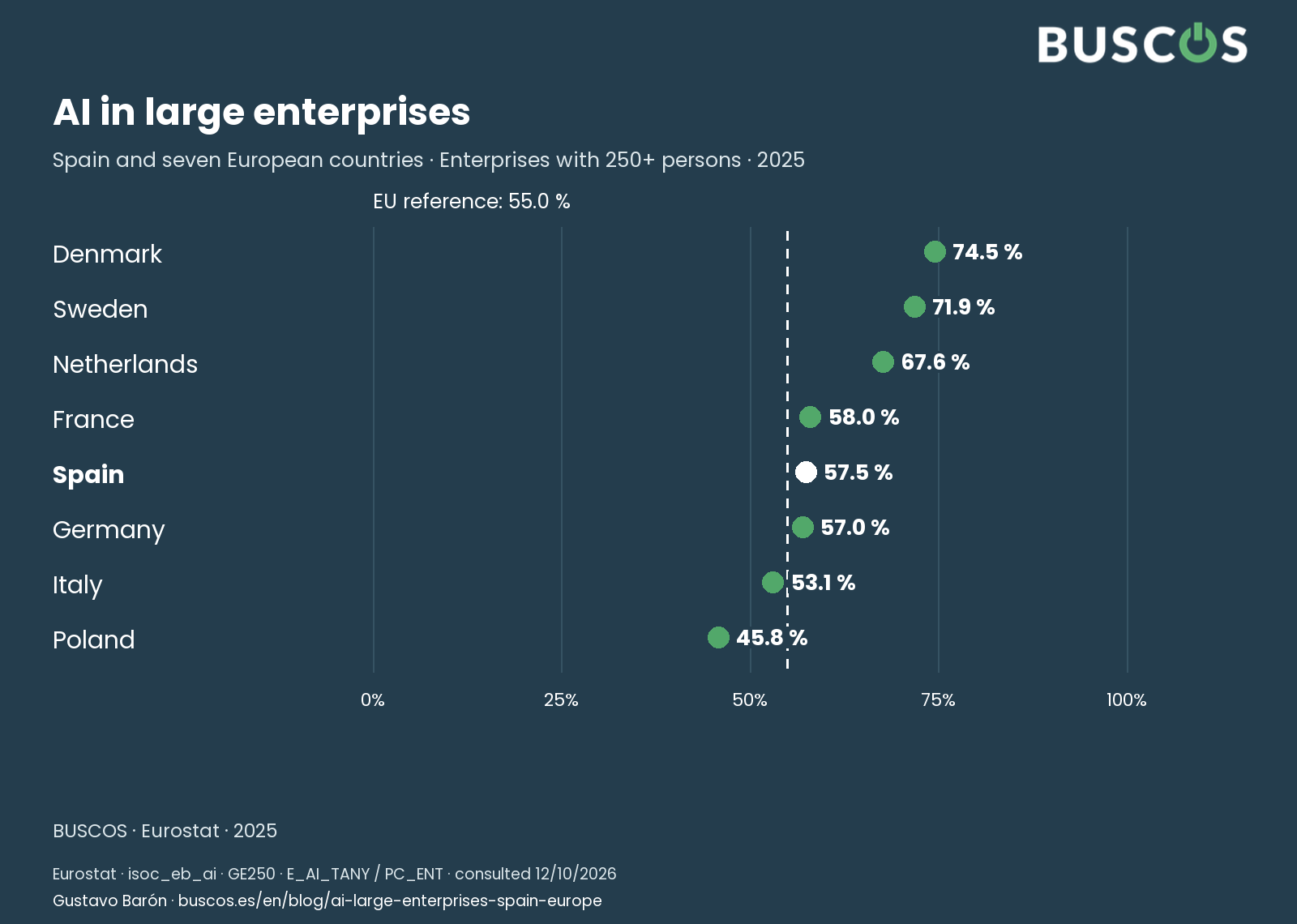
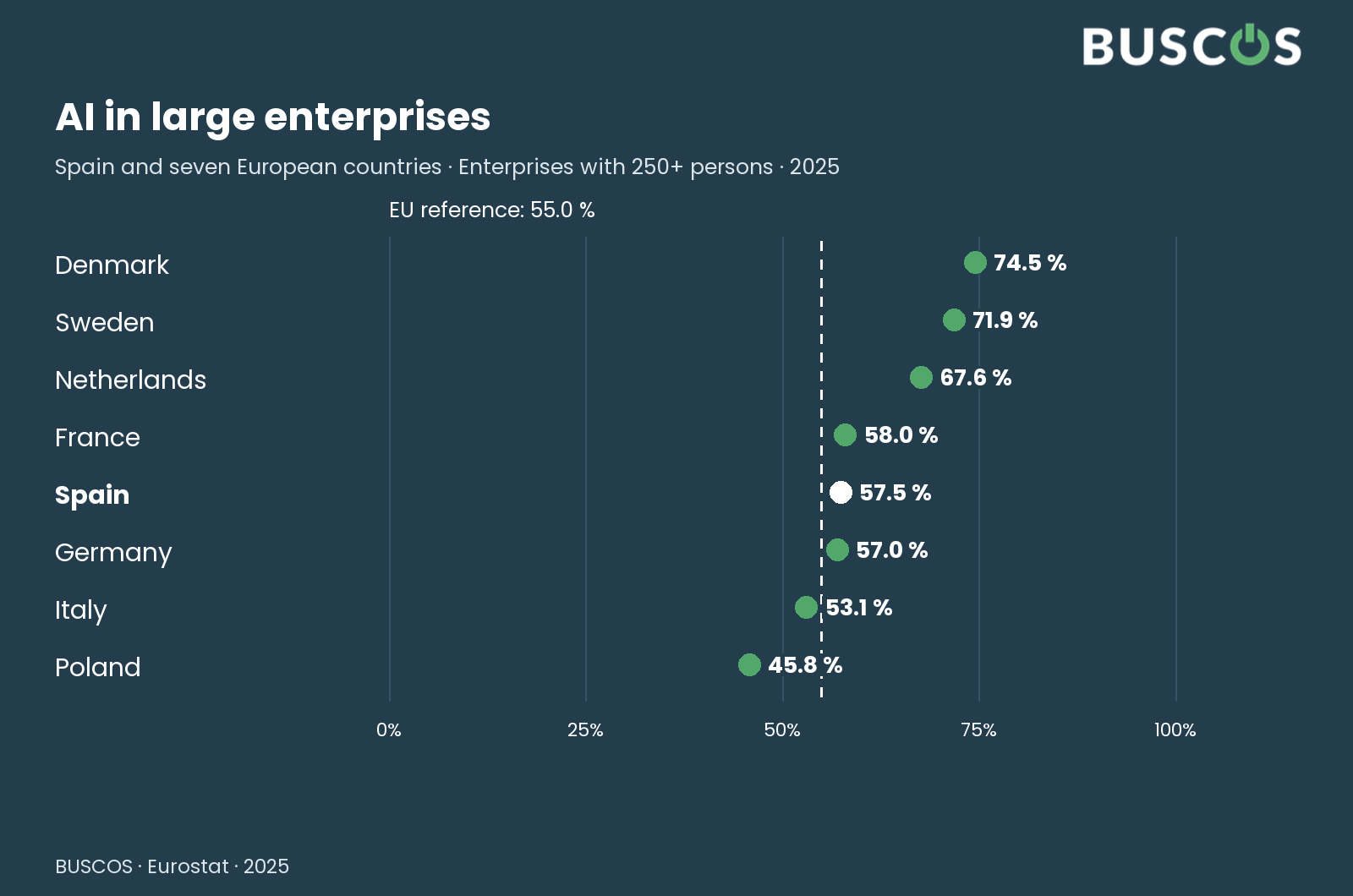
In Spain, 57.5% of enterprises with 250 or more persons employed reported using at least one artificial intelligence technology in 2025. In the European Union, the proportion was 55.0%. In both cases, AI use now reaches most large enterprises in the sectors studied by Eurostat.
It is worth looking at what the indicator counts. Using just one of the technologies covered is enough to be included in that percentage. One business may use AI for a marketing task, another for IT security and another for production. All three count as users, although their work, needs and results may be very different.
That is why the figure opens a more useful conversation than asking whether a business has AI. What work does it use AI for? Who checks what it does? What information does it need? As use becomes more widespread, these questions help distinguish an available tool from an improvement the team can recognise.
Spain, France and Germany are close; Denmark and Sweden stand apart
Among the eight selected countries, Denmark records 74.5% and Sweden 71.9%. The Netherlands reaches 67.6%. These are examples of higher adoption than Spain among enterprises with 250 or more persons employed.
France, Spain and Germany occupy a much narrower band: 58.0%, 57.5% and 57.0%, respectively. Italy stands at 53.1% and Poland at 45.8%. Spain is slightly above the European aggregate, but about seventeen percentage points below Denmark.
The proximity of France, Spain and Germany helps put the chart in perspective: a few tenths of a percentage point do not show that businesses in one country work better with AI. Nor is this a complete ranking of Europe. The selection retains the comparators from the first article and compares large enterprises using the same indicator.
| Territory | Small · 10–49 | Medium · 50–249 | Large · 250+ |
|---|---|---|---|
| Denmark | 37.5% | 58.3% | 74.5% |
| Sweden | 30.7% | 49.6% | 71.9% |
| Netherlands | 28.8% (b) | 46.6% | 67.6% |
| France | 15.0% | 30.8% | 58.0% |
| Spain | 17.2% | 30.1% | 57.5% |
| Germany | 23.1% | 35.6% | 57.0% |
| Italy | 14.2% | 27.6% | 53.1% |
| Poland | 5.8% | 14.8% | 45.8% |
| EU-27 | 17.0% | 30.4% | 55.0% |
Percentage of enterprises within each size class; figures rounded to one decimal. EU-27 is the European aggregate, not another country. Microenterprises are outside this comparison. (b) Eurostat flags a break in series for small enterprises in the Netherlands; this flag does not apply to its medium or large enterprises.
Business size makes a large difference to the proportion of AI users
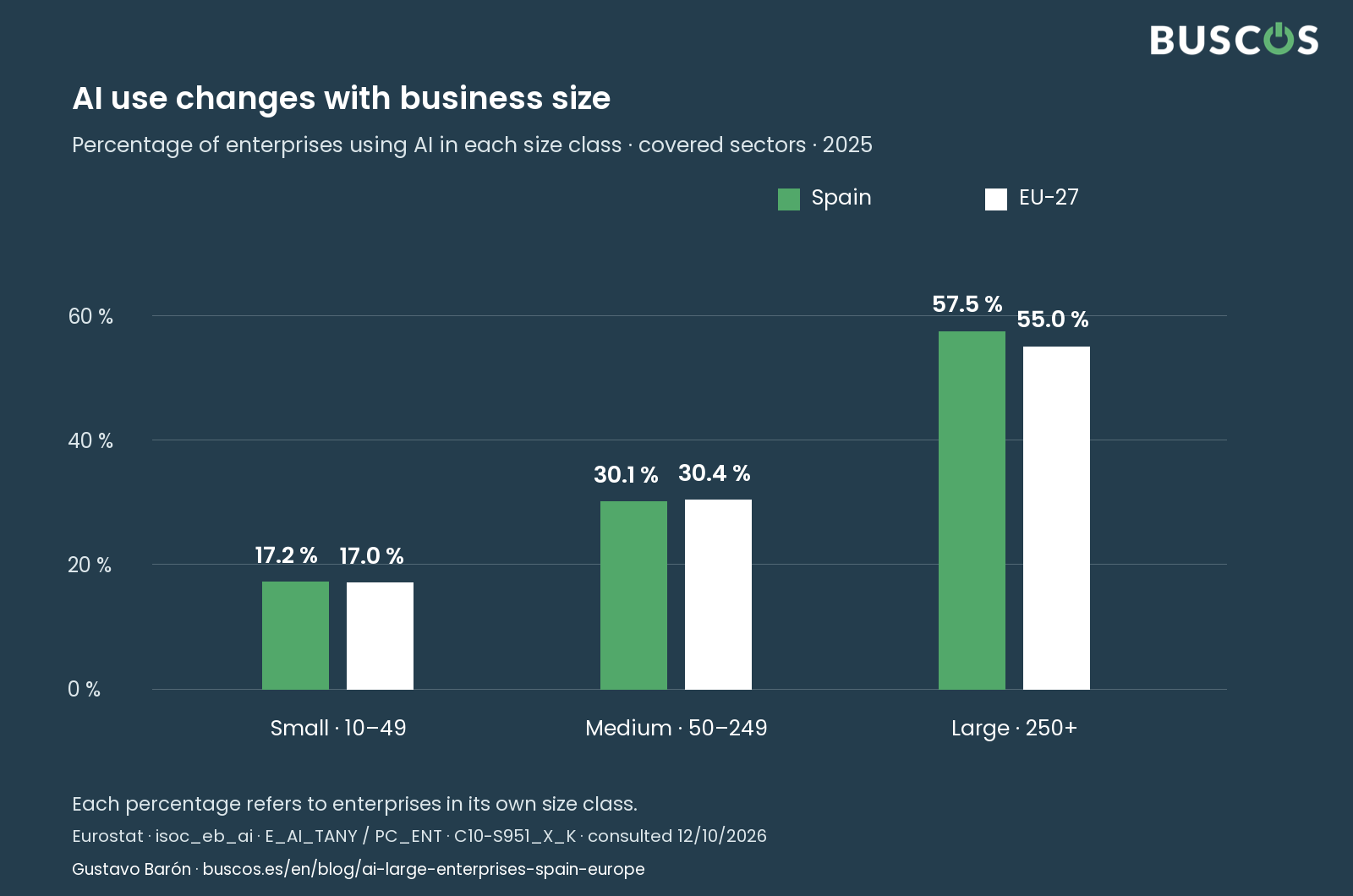
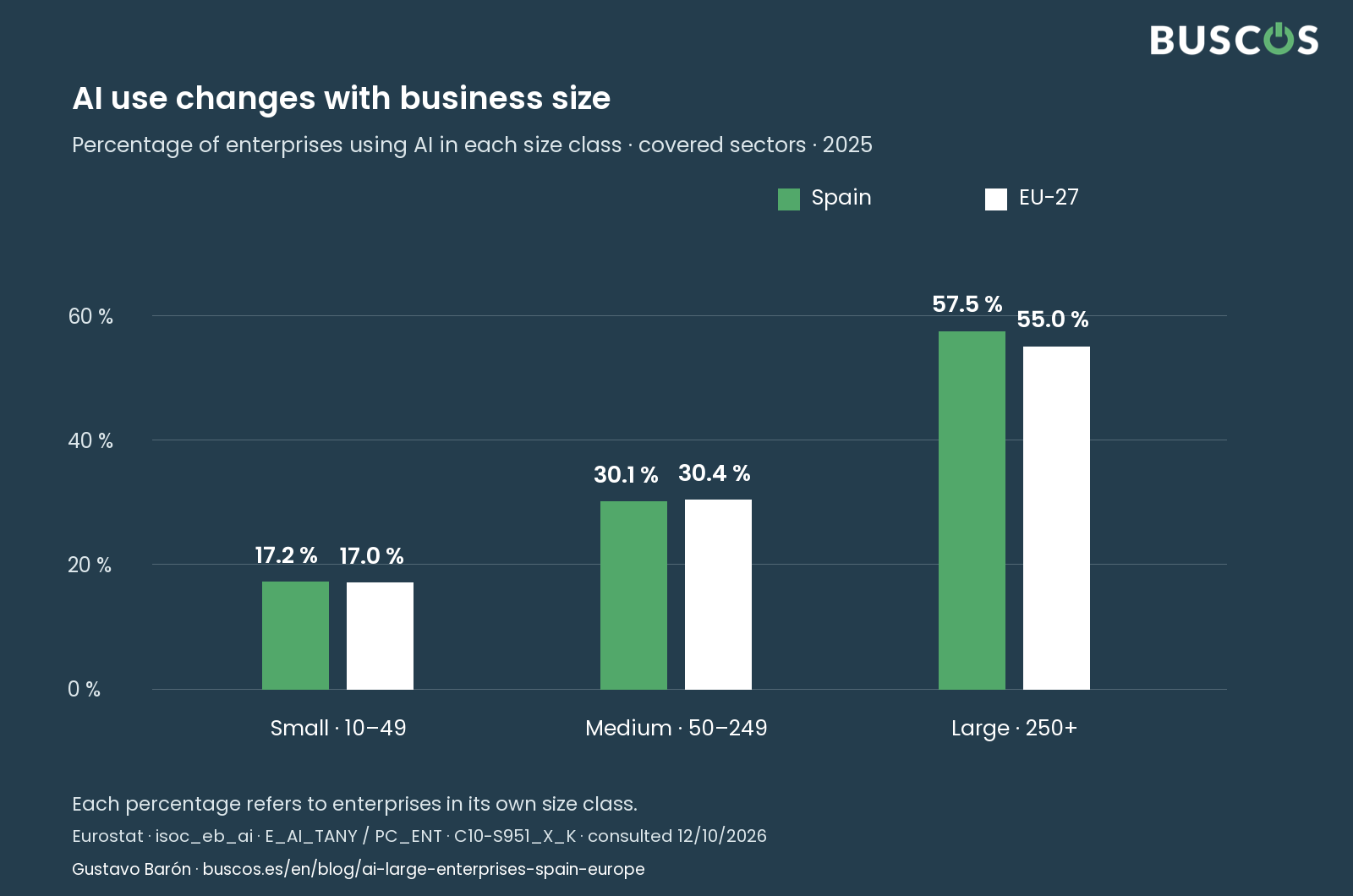
When Spanish enterprises are separated by size, adoption rises from 17.2% among small enterprises with 10 to 49 persons employed to 30.1% among medium-sized enterprises with 50 to 249, and 57.5% among large enterprises. The gap between small and large enterprises is 40.3 percentage points, calculated before rounding.
The EU shows the same pattern: 17.0%, 30.4% and 55.0%. In Spain, the proportion of large enterprises using AI is more than three times the proportion of small enterprises. This describes how widespread use is within each size class; it does not mean a large business gains three times as much productivity.
These data do not explain why adoption changes with business size. For an individual business, the practical question is which work deserves attention and what information, time and knowledge are available to tackle it.
Enterprises with fewer than ten persons employed are outside this comparison. If your business has two, five or eight people, it would be incorrect to assign it the percentage for small enterprises in this survey. The question arising from the analysis can still be useful: which task do you want to improve first?
What they use AI for: administration, security, sales and production
Eurostat offers another perspective: the purposes for which enterprises use AI. The base changes here. The following percentages refer only to enterprises already using an AI technology, within each size class. An enterprise may report several purposes.
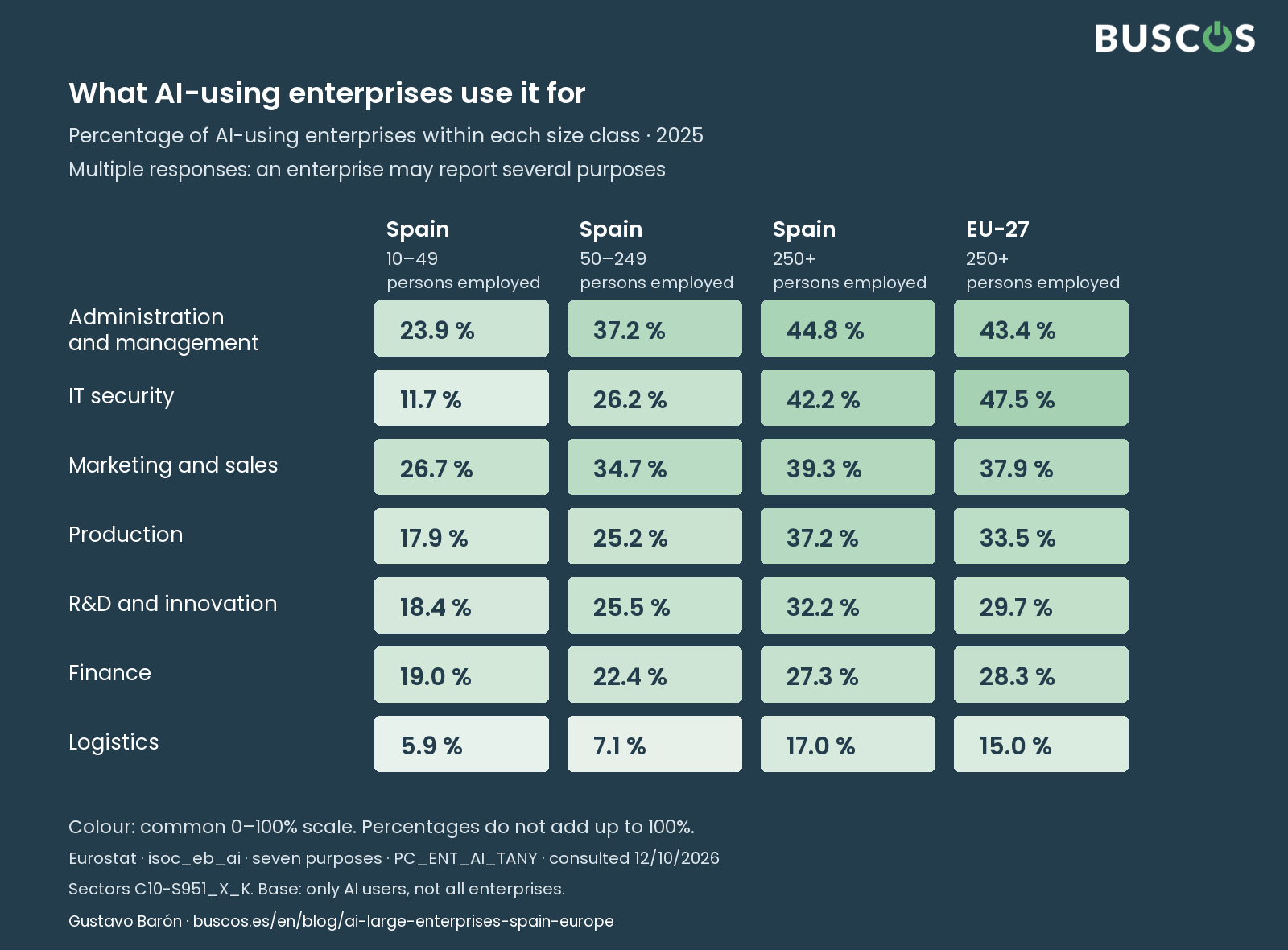
Among large Spanish enterprises using AI, 44.8% report using it to organise administrative or management processes; 42.2% for IT security; 39.3% for marketing or sales; and 37.2% for production. The table also includes finance, logistics, and research, development or innovation.
Comparison with the EU adds detail. For IT security, large Spanish AI users record 42.2%, compared with 47.5% in the EU. For administration and management, the figures are 44.8% and 43.4%. Slightly higher overall adoption in Spain can coexist with a lower proportion for a particular use: the questions and the bases differ.
An example helps explain this. IT security is reported by 42.2% of large Spanish enterprises that use AI. When the denominator includes all large Spanish enterprises in the survey, including those not using AI, the published indicator is 24.2%. These are not contradictory estimates: they describe different groups.
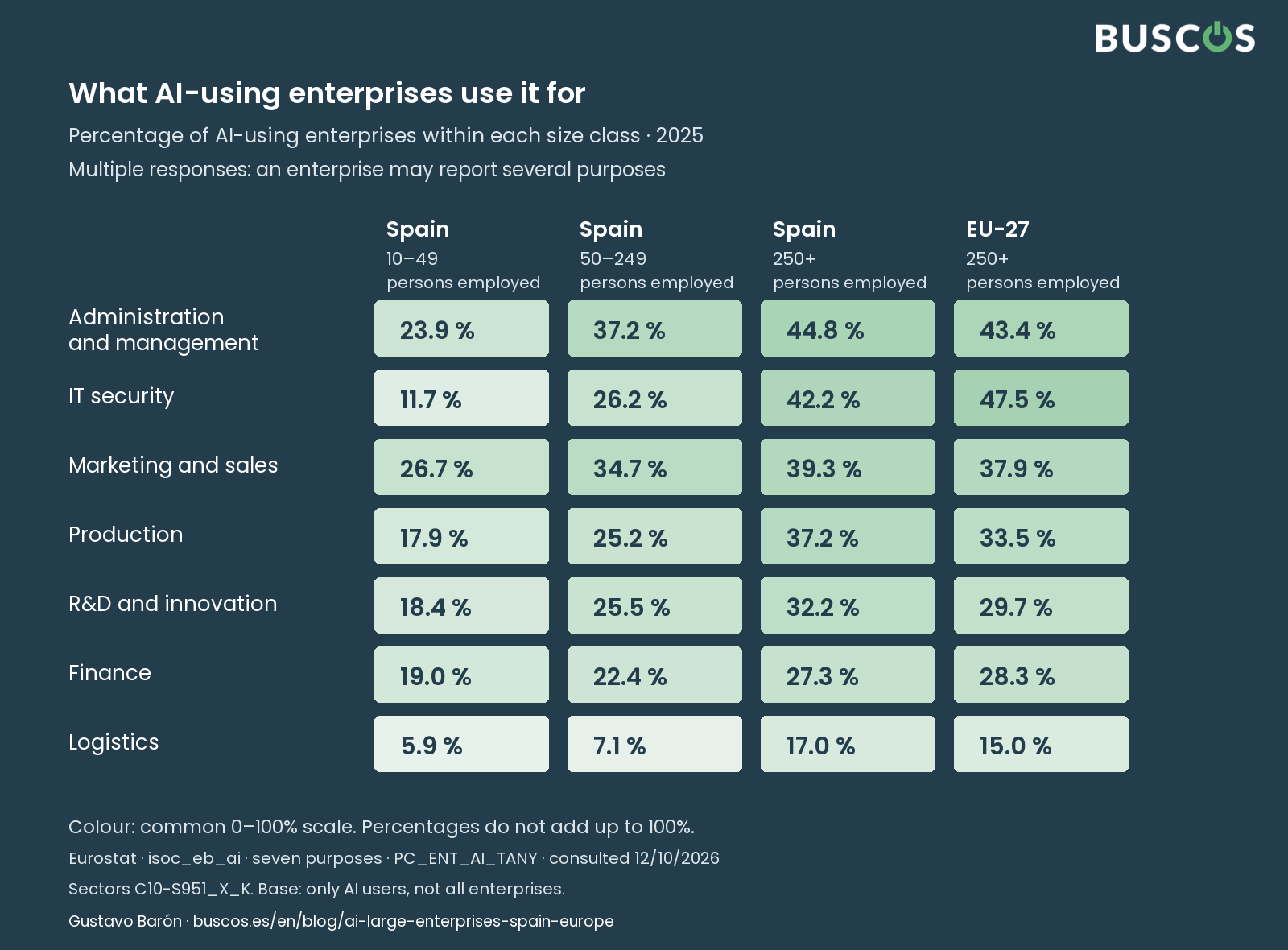
| Purpose | Spain · 10–49 | Spain · 50–249 | Spain · 250+ | EU · 250+ |
|---|---|---|---|---|
| Administration and management | 23.9% | 37.2% | 44.8% | 43.4% |
| IT security | 11.7% | 26.2% | 42.2% | 47.5% |
| Marketing and sales | 26.7% | 34.7% | 39.3% | 37.9% |
| Production | 17.9% | 25.2% | 37.2% | 33.5% |
| R&D and innovation | 18.4% | 25.5% | 32.2% | 29.7% |
| Finance | 19.0% | 22.4% | 27.3% | 28.3% |
| Logistics | 5.9% | 7.1% | 17.0% | 15.0% |
Only enterprises already using AI, within each size class and territory. An enterprise may report several purposes; columns do not add up to 100%. Figures rounded to one decimal. N/A means data not available, not zero.
Small AI users show a different distribution of priorities
Among small Spanish enterprises already using AI, IT security reaches 11.7%, compared with 42.2% among large AI users. Administration and management rises from 23.9% to 44.8%. For marketing and sales, the figures are 26.7% and 39.3%, respectively.
These contrasts show where use is more common within each group. They do not turn a large business's priority into an instruction for a small one. A business with few people may need to solve a very specific problem; another may need to coordinate several teams working with different information and responsibilities.
Nor does the table measure budgets, implementation quality or savings achieved. Answering those questions requires information about the work: how it is done today, which errors arise, how much time it takes and what result would justify changing it. Public statistics provide context; that detail helps define the assignment.
When several teams are involved, the proposal must connect their work
For example, a solution for preparing orders may need sales information, stock levels and invoicing conditions. Before deciding how to automate it, describe who supplies each piece of information, its source and who confirms an exception. This is an illustration of work, not a result attributed to an enterprise in the survey.
The review starts with familiar questions: where is information copied again? Which missing detail makes someone stop and ask a colleague? Which error must prevent the process from continuing? Following that workflow helps define the problem before comparing tools or asking a provider for a proposal.
The team also needs to know what to observe during a trial. An impressive demonstration may depend on prepared examples. Checking relevant work cases makes it possible to discuss limits, errors and responsibilities that should be clear before expanding use.
What to ask a provider before commissioning a solution
A proposal is easier to assess when it explains which task it will solve, what information it will use, how it will fit the current work and what will be checked before accepting it. It should also clarify who handles incidents and what the team needs to learn to use it.
The statistics in this article help formulate better questions, but they do not choose a provider. If you need help finding a specialist business, the starting point remains the specific assignment. That description makes it possible to check what the provider can do, what evidence it offers and what still needs to be verified.
In Spain and the EU, most large enterprises already report some AI use. The opportunity for your business emerges when you define an improvement of your own: where action is needed, who can offer a solution and how to check that it addresses the work you need to resolve.
Sources and how to read the data
Eurostat, isoc_eb_ai. Reference period 2025; dataset revised 15 June 2026 and consulted 12 October 2026. Adoption: E_AI_TANY / PC_ENT. Purposes: seven E_AI_P* indicators, unit PC_ENT_AI_TANY. Security among all large enterprises: E_AI_PITS / PC_ENT. Small: 10–49 persons employed; medium: 50–249; large: 250 or more. Coverage: C10-S951_X_K, manufacturing, utilities, construction, trade, transport, accommodation and food services, information, real estate, professional and administrative activities, and repair of computers and communication equipment. Agriculture, mining, finance, public administration, education and health are among the excluded activities. The country selection does not cover all EU member states. Figures do not measure profitability or implementation results. Original publication: 12 October 2026.