
82.4% needs a complete sentence
82.4% catches the eye. Yet saying that eight out of ten Spanish businesses do not know how to work with AI would change the statistic's meaning. Eurostat asks about reasons for not using it within a specific group: enterprises that considered these technologies but still do not use them. Within that group, and only that group, 82.4% report a lack of knowledge or experience.
The survey covers enterprises with ten or more persons employed in the activities included. It does not describe all self-employed people and small businesses, or examine each worker. It records a business response about a perceived difficulty. It cannot tell us whether the missing element is a technical skill, a way of organising work or someone who can help make sense of the options.
That makes the finding more interesting, not less. Some businesses have already considered AI and still find the next step difficult. Before offering another course or another tool, it helps to ask what work they tried to address and what they needed to move forward.
Spain and the EU report different combinations of difficulties
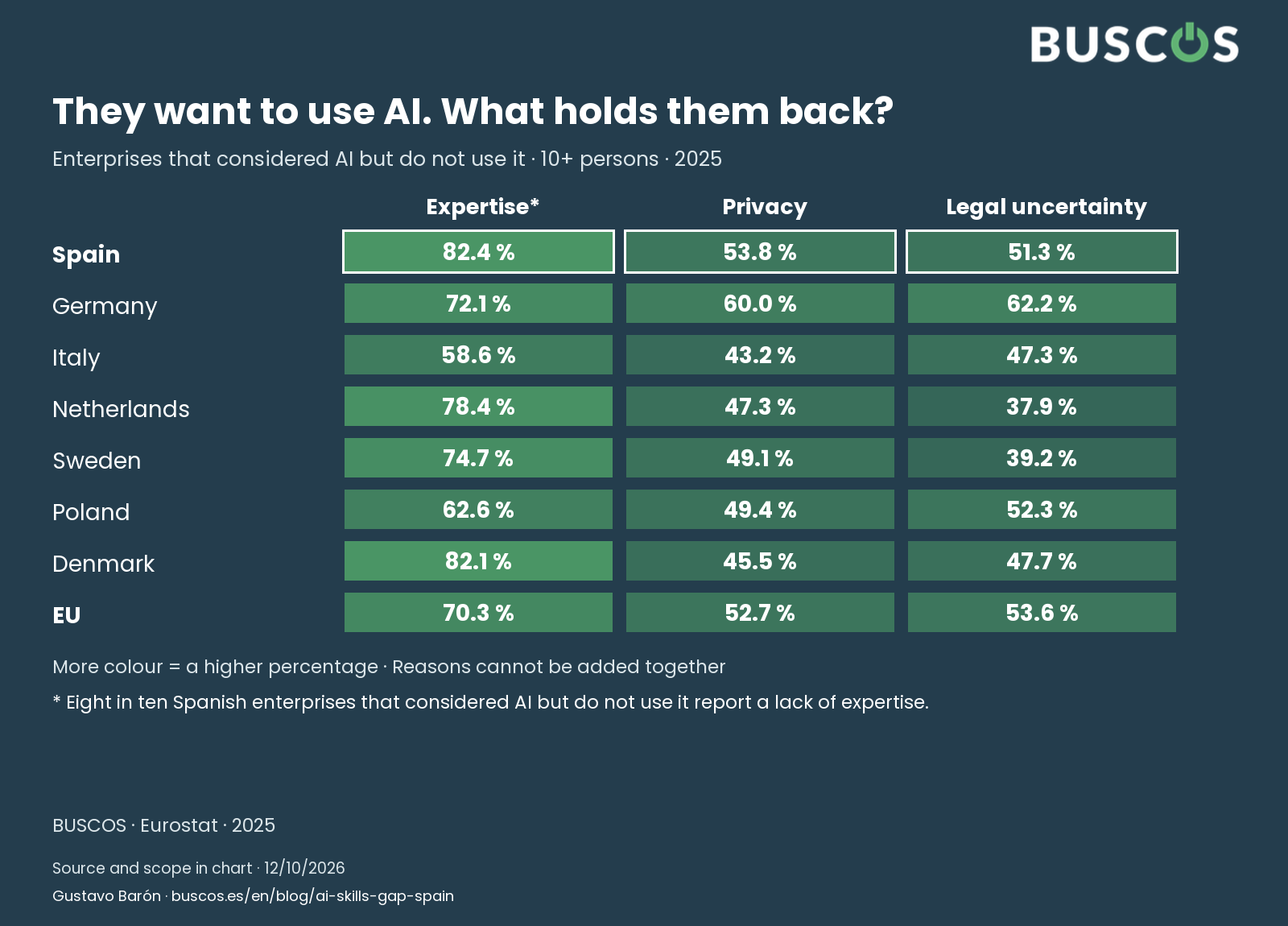
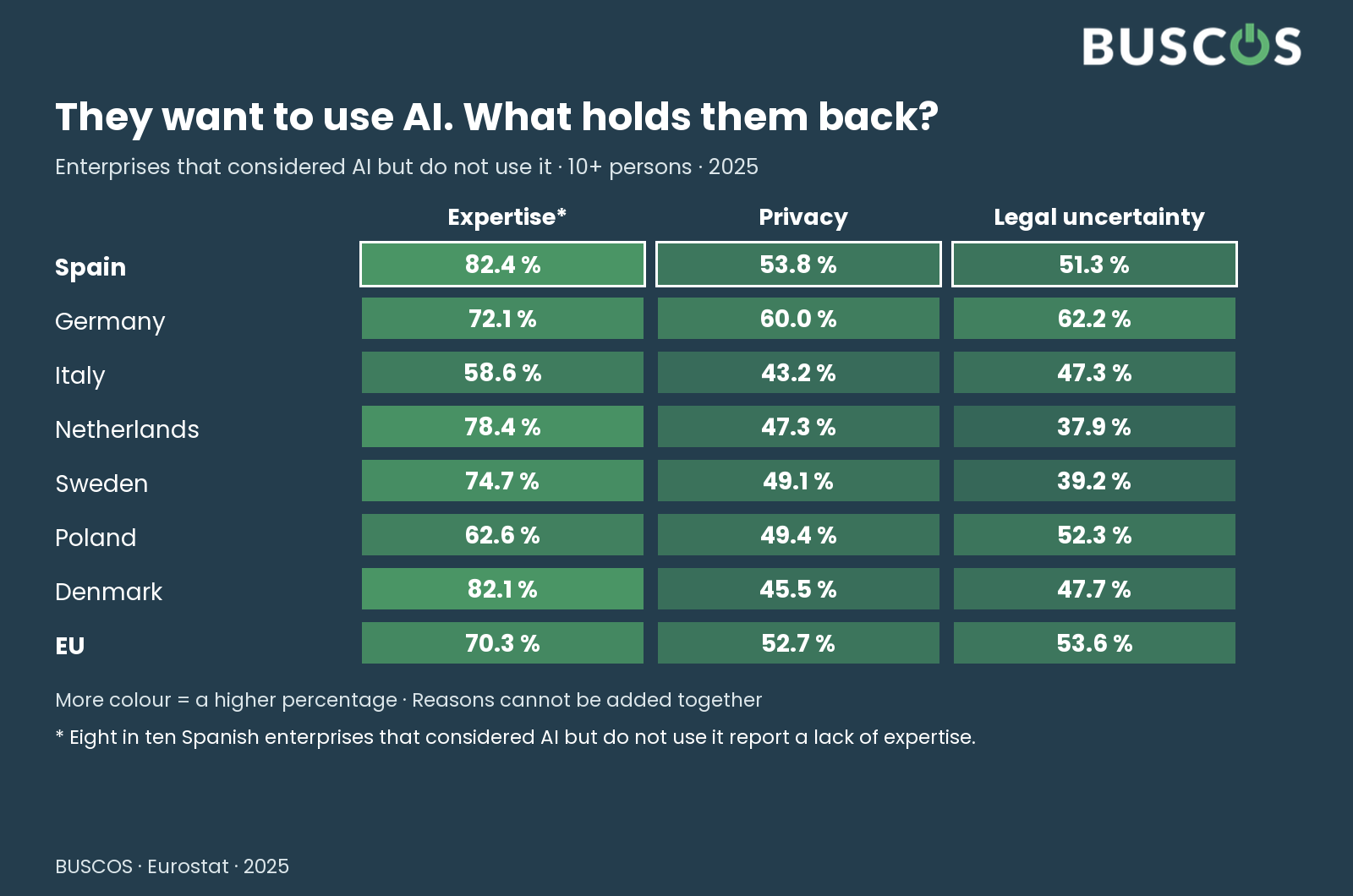
Among enterprises that considered AI but do not use it, lack of expertise reaches 82.4% in Spain and 70.3% in the EU benchmark. Privacy responses are much closer: 53.8% and 52.7%. For uncertainty about legal consequences, Spain records 51.3% and the EU 53.6%. There is no single distance between Spain and Europe: it depends on the question.
The chart retains these three comparisons because they separate different problems. Learning to request a summary does not, by itself, settle which documents may be used. Access to a tool does not establish who checks a response before it reaches a customer. These issues can coexist within one project.
Lack of expertise should therefore not be read as an automatic demand for general training. The useful question is more specific: what should the team be able to do, what information would it handle and which decisions would need checking? That description helps distinguish learning, reviewing a proposal and obtaining specialist support.
Eight reasons, not eight mutually exclusive choices
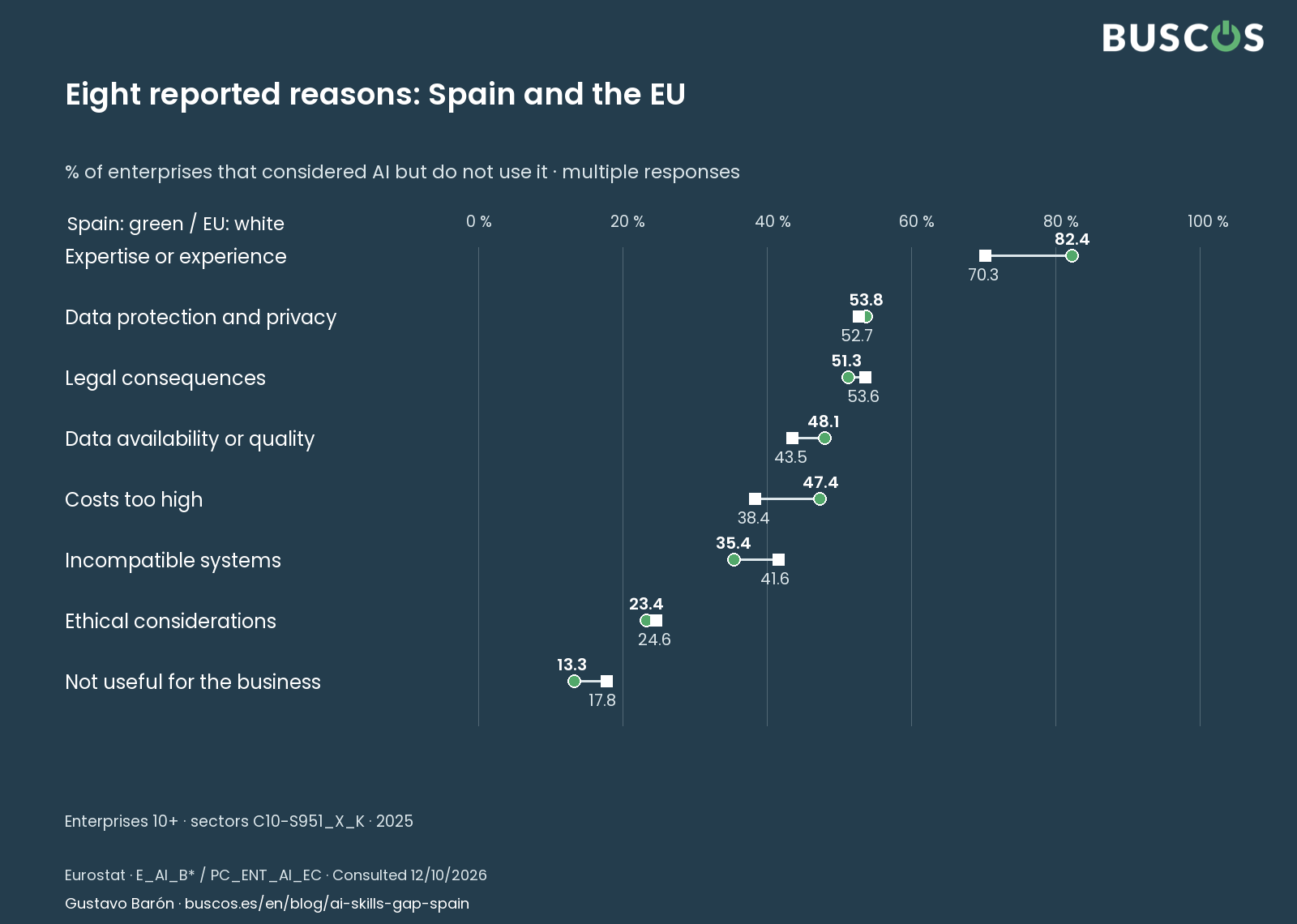
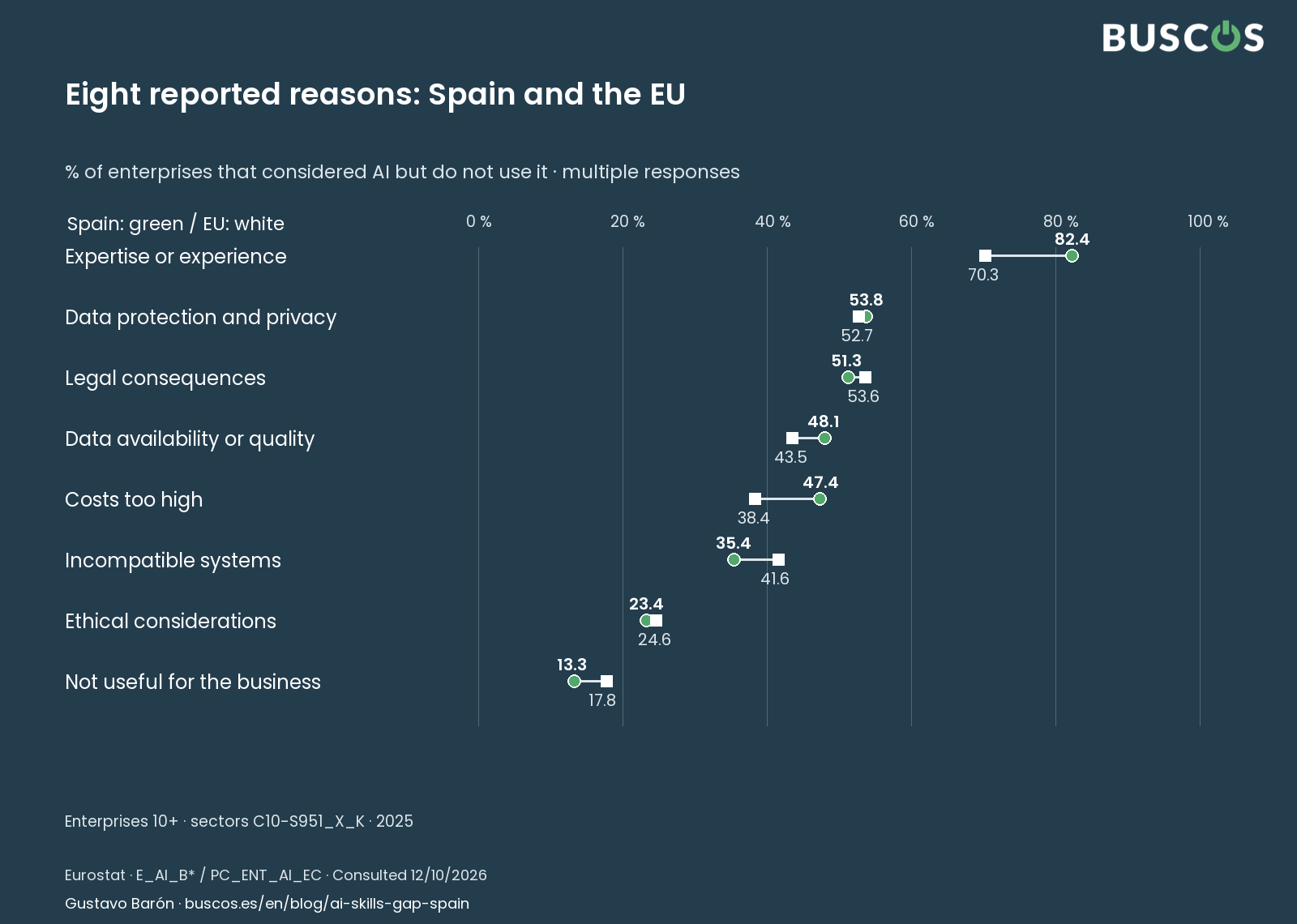
Expertise is the most frequently reported reason within the Spanish group. Privacy, legal uncertainty, data availability or quality, and cost follow. The table also includes incompatibility with existing systems, ethical concerns and a lack of usefulness for the enterprise. Looking only at the tallest bar would miss the rest.
Respondents could give multiple answers. One enterprise could report several reasons, so the percentages must not be added as if they divided a single problem. Nor does this table reveal the combinations chosen by individual businesses. We cannot say that every business reporting cost also reports a lack of expertise.
The practical reading is to review the task's conditions. If information is incomplete, training in a tool might improve its use while leaving the data problem untouched. If permissions are unclear, the team needs to resolve them before real documents enter a solution. Learning should respond to the work the business wants to do.
| Reason | Spain | EU-27 |
|---|---|---|
| Expertise or experience | 82.4 % | 70.3 % |
| Data protection and privacy | 53.8 % | 52.7 % |
| Legal consequences | 51.3 % | 53.6 % |
| Data availability or quality | 48.1 % | 43.5 % |
| Costs too high | 47.4 % | 38.4 % |
| Incompatible systems | 35.4 % | 41.6 % |
| Ethical considerations | 23.4 % | 24.6 % |
| Not useful for the business | 13.3 % | 17.8 % |
Enterprises 10+ that considered AI but do not use it. Multiple responses do not add to 100%.
Who considered AI changes the interpretation
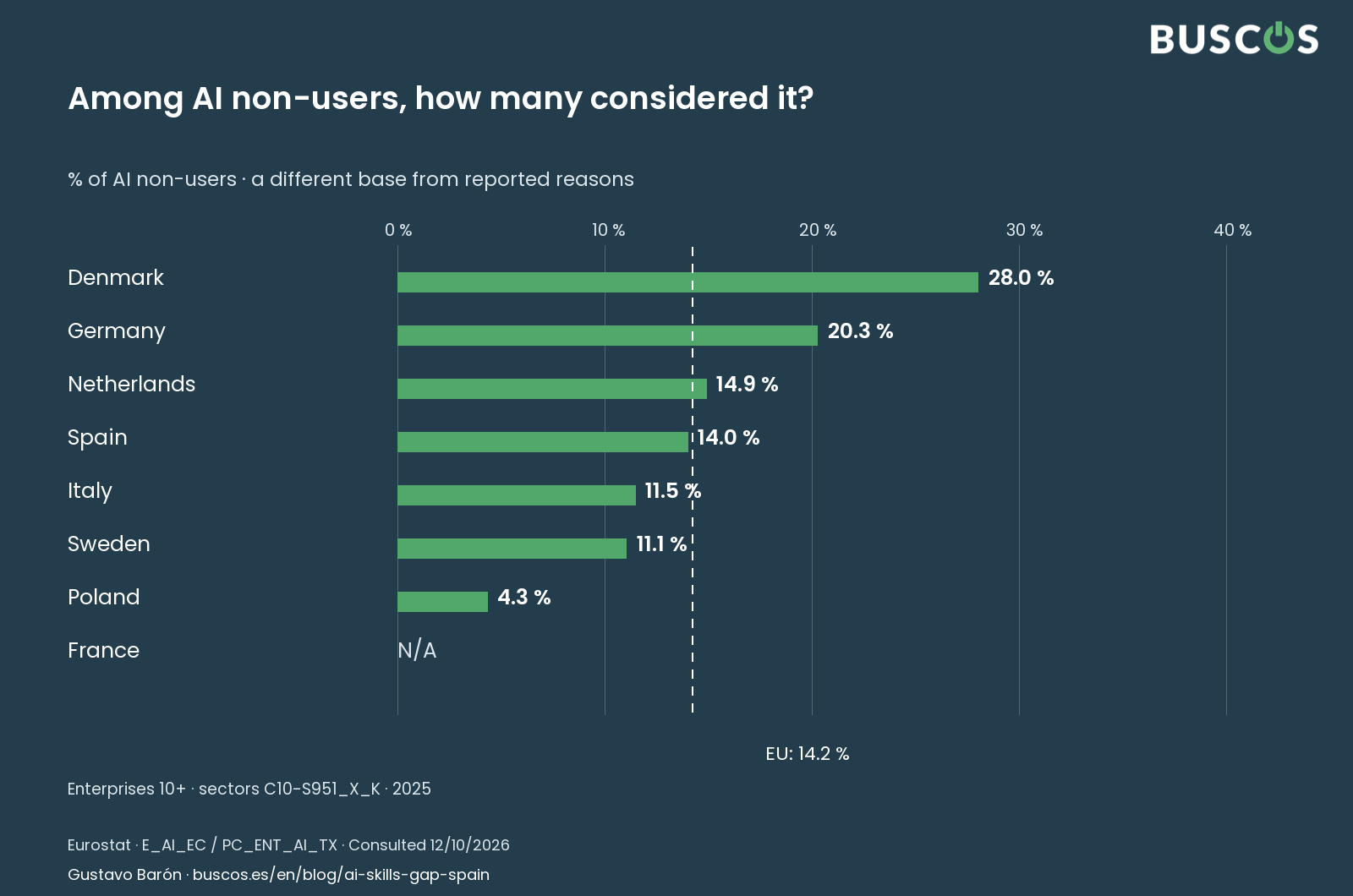
A separate question is how many non-users ever considered AI. Spain records 14.0%, Denmark 28.0% and Poland 4.3%. The group asked about barriers therefore has a different relative size in each country.
Within that group, Denmark reports a lack of expertise at almost the same rate as Spain, even though its overall adoption is much higher, as the first article showed. This does not prove that training is irrelevant. It shows that economies with different levels of use can share a difficulty among businesses that have not yet taken the step.
We do not multiply these percentages to calculate a supposed number of businesses needing a course. The published indicators refer to different populations, and aggregates do not describe individual needs. France appears as N/A where these indicators are unavailable. Missing information is never treated as zero.
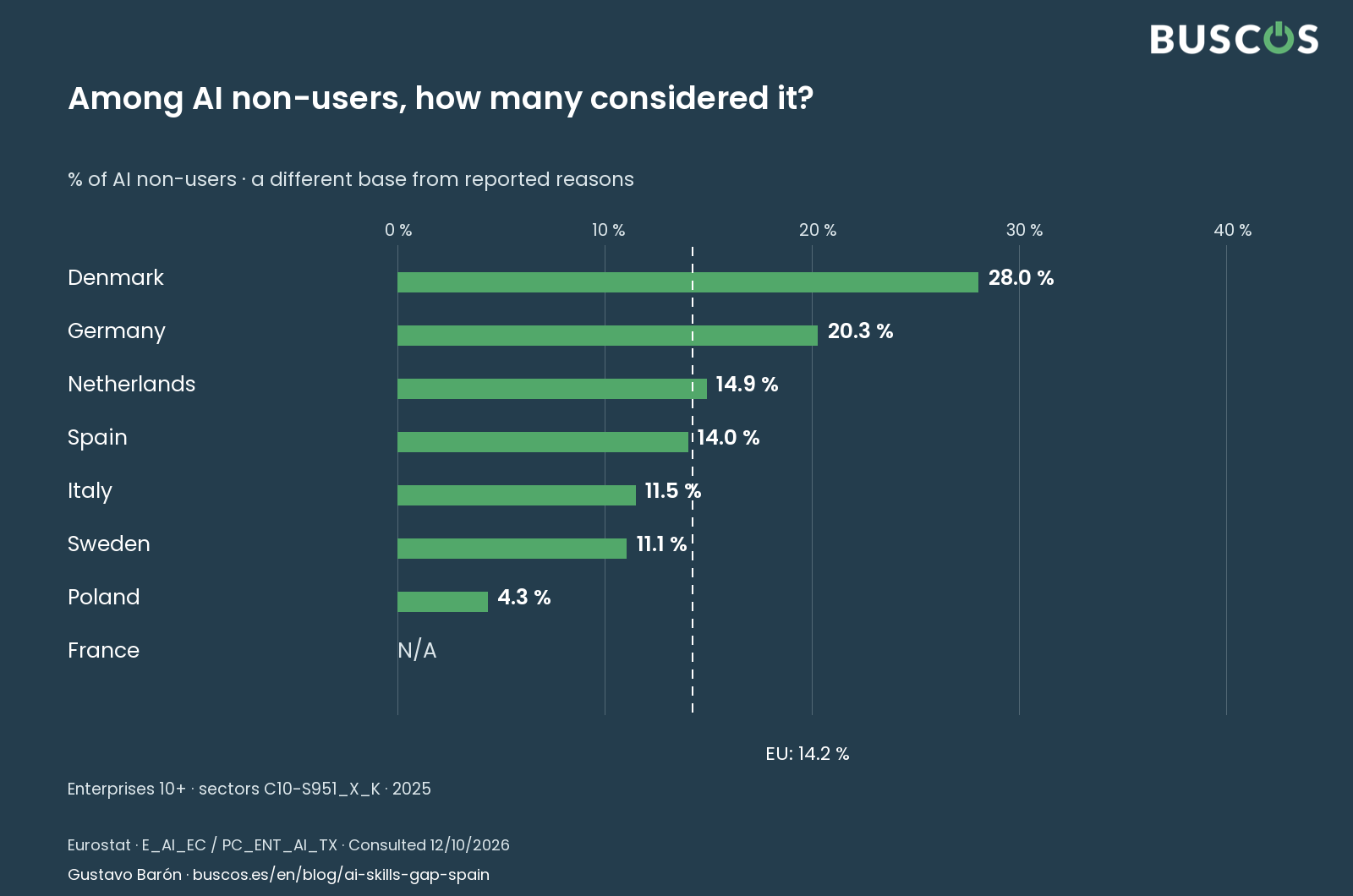
| Country or benchmark | Considered AI among non-users | Expertise among those who considered it |
|---|---|---|
| Spain | 14.0 % | 82.4 % |
| Denmark | 28.0 % | 82.1 % |
| Sweden | 11.1 % | 74.7 % |
| Netherlands | 14.9 % | 78.4 % |
| Germany | 20.3 % | 72.1 % |
| Italy | 11.5 % | 58.6 % |
| Poland | 4.3 % | 62.6 % |
| France | N/A | N/A |
| EU-27 | 14.2 % | 70.3 % |
Column two refers to AI non-users; column three to enterprises that considered AI but do not use it. N/A: not available. Do not multiply them or treat them as the same population.
Start with a task the team needs to be able to handle
Imagine a team receiving enquiries by email. Saying it needs to learn AI leaves most decisions open. The need becomes clearer when we explain that it must find current information, prepare a response, recognise missing data and know when to ask for help before sending it. This is an illustrative task, not an observed client result.
Someone may write well and need practice checking references. Another person may know the process but need help deciding what information should reach the tool. Maintaining an integration requires different skills from reviewing its output. Defining these responsibilities does not require turning everyone into a developer.
Useful training would work with relevant tasks and examples, including cases where a proposed answer is wrong or incomplete. The goal is not to repeat a list of instructions. It is to recognise what can be accepted, what needs correcting and what requires a decision from a responsible person.
How to compare two training proposals
Two programmes may mention the same tools while preparing a team for very different work. To compare them, ask for examples of tasks participants will practise, what information will be used and how an incorrect answer will be reviewed. A tool name alone does not explain what someone will learn to do.
What happens after the session matters too: whether the team can repeat the task with new cases, where references remain available and who can help when an exception appears. Checks should focus on a relevant working skill, not a global grade for a person or a promise of future performance.
When a proposal combines training and implementation, distinguish the deliverables of each part. Learning to review information and developing an integration are different jobs. Clear responsibilities and deliverables help assess whether a programme meets the need rather than choosing by the number of tools, hours or technical terms in its syllabus.
Learn internally, bring someone in or seek external help
A lack of expertise can be addressed in different ways. If a task is recurring and the team already understands its conditions, learning to handle it better may make sense. If it requires ongoing technical work nobody can take on, a professional may be needed. A defined assignment requiring a specific specialism may be better suited to a provider.
The statistic does not select an option automatically. Frequency, available data, responsibility for maintaining a solution and the ability to check it all change what the business should ask for. A proposal should explain who will do each part and how the business will know whether it meets the need.
Before buying training, write down one task, one difficulty and one way to check an improvement. That small description supports a more useful conversation than asking for an AI course for everybody. It helps examine what the team needs to learn and what support may be necessary, without assuming a hire or a particular tool.
Sources and how to read the data
Primary sources consulted on 12 October 2026. Practical examples are BUSCOS interpretations, not client results.