Quick summary
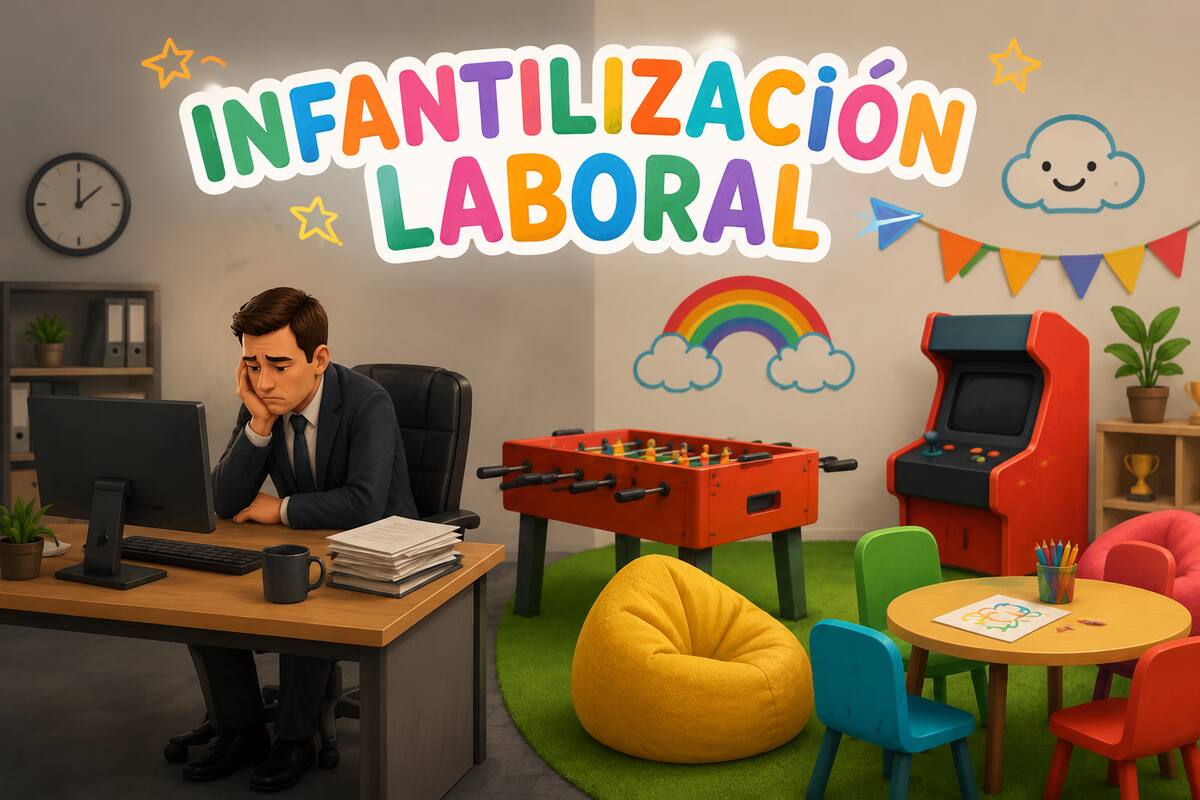
The company has just installed a foosball table. Human Resources announces an escape room, a themed breakfast and an after-work team outing. The email says attendance is voluntary, although everyone knows the manager will be there and people will notice on Monday who came and who did not.
The intention is probably good: improve the atmosphere, bring the group together and show that work can also be fun. Some employees may genuinely enjoy it. Others may be thinking: I would rather leave on time; that budget could support training; I have two children and my free time already belongs somewhere; I do not need to play with my manager to be committed to my work.
The argument is not that team building is bad or that work must be grey. Well-designed social activities can improve trust and collaboration.
The problem is not playing foosball. The problem is trying to replace good management with entertainment.
-
What it solves
Workplace infantilisation appears when an organisation treats adult professionals as if they needed playful stimuli, superficial rewards or constant animation to do their jobs, instead of providing autonomy, resources, clear objectives, recognition and reasonable conditions.
-
Useful complement
It would be inaccurate to claim that all team activities are useless.
-
Where BUSCOS fits
BUSCOS turns real role situations into short scenarios so interviews begin with evidence of reasoning, priorities and communication.
What workplace infantilisation means
Workplace infantilisation appears when an organisation treats adult professionals as if they needed playful stimuli, superficial rewards or constant animation to do their jobs, instead of providing autonomy, resources, clear objectives, recognition and reasonable conditions.
It does not depend on a particular object. An office does not automatically infantilise anyone because it has a console, a ping-pong table or a pleasant kitchen. These may be appreciated by people who choose to use them.
The logic becomes paternalistic when the company tries to become a second home, expects enthusiasm as well as professionalism, makes supposedly voluntary activities socially compulsory or confuses integration with availability outside working hours.
It also appears when games, gifts or motivational messages avoid conversations about leadership, workload, pay or development, and when declining to participate is interpreted as a lack of commitment.
The implicit message is strange: doing your work well, collaborating and fulfilling your responsibilities is not enough; you must also have fun in the way chosen for you.
Key points
- Workplace infantilisation appears when an organisation treats adult professionals as if they needed playful stimuli, superficial rewards or constant animation to do their jobs, instead of providing autonomy, resources, clear objectives, recognition and reasonable conditions.
- It does not depend on a particular object.
Confusing commitment with entertainment
Someone can be deeply committed to their work without wanting to play ping-pong with their manager.
They may enjoy solving a complex problem, serving a customer well, completing payroll without errors, teaching a colleague or delivering a project they are proud of. They may be generous and constructive with the team and still want to leave at five to be with their children, train, care for a relative, study or simply be alone.
That is not disengagement. It is having a life.
The 2024 European Working Conditions Survey, based on more than 36,600 interviews, reports that over 80 per cent of workers consider their work useful and feel they do a good job. Professional meaning exists without turning every day into a recreational experience. The same survey says 33 per cent would prefer to work fewer hours.
Self-determination theory identifies three particularly relevant psychological needs: autonomy to choose and act, competence to do the work well and progress, and relatedness to feel respected and supported.
A 2026 meta-analysis of 192 studies on the application of this theory at work confirmed consistent relationships between support for those needs and job satisfaction, engagement and wellbeing.
A social activity can strengthen relatedness. If it is imposed, or people are symbolically punished for not joining, it weakens autonomy. The same event can be enjoyable for one person and an uncomfortable obligation for another.
Key points
- Someone can be deeply committed to their work without wanting to play ping-pong with their manager.
- They may enjoy solving a complex problem, serving a customer well, completing payroll without errors, teaching a colleague or delivering a project they are proud of.
Team building can work; mandatory fun is different
It would be inaccurate to claim that all team activities are useless. A meta-analysis published in Small Group Research, based on 60 correlations, found a moderate positive effect of team building on team outcomes, especially affective and process outcomes.
However, the team building studied was not simply bowling or rafting. The interventions addressed goal setting, role clarification, problem solving and interpersonal relations.
Three of those four components concern how work is done. Sometimes the best way to bring a team together is not to remove it from its context, but to help people understand who decides, how tasks are coordinated, which conflicts are being avoided and what problem they need to solve together.
Research by Ethan Mollick and Nancy Rothbard on mandatory fun adds the essential nuance. In a field experiment, management-led games increased positive affect when employees accepted and legitimised the activity. Without that consent, the effect on positive affect was negative.
Organic fun happens spontaneously, adapts to the group and requires nobody to prove anything by participating. Managed fun appears when the company designs an experience for an organisational objective and expects a particular emotional response.
A 2025 review and meta-analysis on fun, engagement and burnout found a meaningful relationship between fun and engagement, while warning that the relationship is complex: engaged people having more fun does not mean any organised activity will create engagement.
An invitation from management is never entirely neutral. If saying no can affect reputation, opportunities or the relationship with a manager, choice exists only in the calendar entry.
Key points
- It would be inaccurate to claim that all team activities are useless.
- However, the team building studied was not simply bowling or rafting.
The new corporate paternalism
Some companies no longer limit themselves to paying a salary, organising work, protecting health and offering development opportunities. They also aspire to create community, belonging, friendship, wellbeing and happiness.
The ambition may be generous, but it carries a risk: invading spaces that belong to the individual.
A company is not a family. It can be a good organisation, a safe place, an excellent team and even the origin of real friendships. It remains a professional relationship with hierarchies, assessment, economic dependence and the power to impose consequences.
When an organisation presents itself as a family, boundaries become harder to draw. Families do not invoice every hour, negotiate pay rises or change supplier when a better offer appears. That language can turn contractual duties into emotional tests of loyalty.
Modern paternalism is usually kinder than the old version. It does not order; it invites. It does not monitor private life; it proposes sharing it. It does not demand enthusiasm; it creates an environment where appearing unenthusiastic has a cost.
The question is therefore not only whether an activity is fun. We should also ask who chose it, when it takes place, what happens if someone does not join and which problem it is meant to solve.
Key points
- Some companies no longer limit themselves to paying a salary, organising work, protecting health and offering development opportunities.
- The ambition may be generous, but it carries a risk: invading spaces that belong to the individual.
Opportunity cost: what an activity communicates
A company party cannot automatically be converted into an equivalent pay rise. Budgets have different characteristics, a one-off activity does not create the recurring cost of higher pay, and some events provide real value at a reasonable cost.
Every spending decision still communicates priorities.
An employee with young children may see a games room and think about the childcare support that does not exist. Someone else would prefer an additional remote-working day. A person with a ninety-minute commute will value flexibility. A professional worried about falling behind may choose training. Someone under financial pressure will prefer pay, transport or health cover.
They are not boring people. They have different priorities.
The 2025 Randstad Employer Brand Research for Spain places pay and benefits, work-life balance and a pleasant work atmosphere as the three leading attributes of an ideal employer. Forty-six per cent of surveyed workers cited better work-life balance as a reason to leave or consider leaving their job.
Atmosphere matters. But a good atmosphere does not necessarily mean frequent parties. It also means being able to disagree without fear, receiving help when a problem arises, avoiding toxic behaviour, having a reasonable workload and trusting what managers say.
Before buying an experience for employees, ask what experience employees actually need.
Key points
- A company party cannot automatically be converted into an equivalent pay rise.
- Every spending decision still communicates priorities.
Culture, country and stage of life change the meaning of a company party
The relationship with work is not experienced in the same way in every culture. In some settings, company social life occupies significant space; in others, the boundary between professional and private life is more strongly protected.
Turning nationality into an automatic explanation would be another mistake. Within one country there are enormous differences by age, occupation, personality, finances, commute, caring responsibilities and stage of life.
An after-work activity does not have the same cost for someone who lives nearby and someone who relies on several forms of transport; for a person without caring duties and someone who must collect a child; for an extrovert and someone who needs to recover after a socially intense day.
It also differs for someone able to join a physical activity and someone with a disability, chronic pain or a health limitation; for a person who drinks alcohol and someone who does not for health, religion, recovery or preference; and for a newcomer compared with an employee who already has a social network outside work.
When the activity takes place outside working hours, the employer is asking for something scarcer than money: personal time. For some it is an opportunity; for others, a cost.
A genuinely inclusive proposal does not require anyone to justify declining. It offers alternatives, avoids informal consequences and, where the objective is work-related, tries to take place during working time.
Key points
- The relationship with work is not experienced in the same way in every culture.
- Turning nationality into an automatic explanation would be another mistake.
Camaraderie is not manufactured; it is demonstrated through work
Companies sometimes appear to be buying emotions that once emerged naturally.
Camaraderie appeared because people solved a difficult problem, covered for one another during an emergency, shared information, admitted an error or kept a promise. Trust grew from seeing that another person responded when it mattered.
Now that connection is sometimes produced from outside through an event. Instead of building a working culture that generates relationships, activities are organised to manufacture relationships the culture is failing to create.
The order is reversed.
A team does not need to be a group of friends. It needs to coordinate, ask for help, disagree respectfully, use different strengths and trust that agreements will be kept. If friendship grows from that, wonderful. Friendship should not be part of the job description.
Key points
- Companies sometimes appear to be buying emotions that once emerged naturally.
- Camaraderie appeared because people solved a difficult problem, covered for one another during an emergency, shared information, admitted an error or kept a promise.
The risk starts in hiring: culture fit is not personal similarity
Infantilisation can also enter recruitment. It happens when culture fit is assessed with questions such as: would I go for a drink with this person, do they have our energy, or would they join our plans?
Those criteria reward similarity, social fluency and personal availability. They can penalise excellent candidates because of age, culture, personality or caring responsibilities without providing relevant evidence about how they will work.
The useful question is not whether someone would have fun with the team, but whether they can collaborate with it.
BUSCOS works in precisely that space: after the CV and before the interview, it turns real role situations into short scenarios that show how a person reasons, prioritises and communicates. Instead of imagining fit from personal affinities, the team reaches the conversation with evidence of professional behaviour.
Diversity is not only about bringing different people in. It also requires us to stop asking them to resemble us before we treat them as part of the group.
Key points
- Infantilisation can also enter recruitment.
- Those criteria reward similarity, social fluency and personal availability.
Observe how someone collaborates, not whether they would go for a drink with you
BUSCOS turns real role situations into short scenarios so interviews begin with evidence of reasoning, priorities and communication. Fit is explored through work, not through availability for the company social life.
- Scenarios tied to real role decisions.
- Original response and observable signals before the interview.
- Concrete follow-up questions to explore collaboration and judgement.
From mandatory fun to an adult workplace culture
| Question | Infantilising signal | Adult design |
|---|---|---|
| Objective | Organise an activity to improve atmosphere without defining the problem. | Agree what should improve: coordination, trust, roles, celebration or mutual knowledge. |
| Choice | Call a plan voluntary when declining carries a social cost. | Allow people to say no without explanations, lost visibility or consequences. |
| Time | Always move the event to evenings or weekends. | If it creates work value, allocate working time to it. |
| Inclusion | Design for the majority and ask everyone else to adapt. | Review accessibility, caring, distance, health, alcohol, noise and alternatives. |
| Management | Use leisure to cover workload, weak leadership or unclear responsibilities. | Address the structural problem with management decisions. |
| Measurement | Count attendance and photographs as evidence of culture. | Check whether the issue that justified the activity has improved. |
Eight questions before organising the next team activity
1. What problem are we trying to solve? Improving the atmosphere is too vague. Is there role conflict, weak trust, poor coordination, teams that do not know one another or simply something worth celebrating? Each need requires a different response.
2. Have we asked people? The organising committee being enthusiastic is not enough. A short anonymous consultation with real options may reveal a different priority.
3. Is it truly voluntary? People who decline should not lose visibility, information, opportunities or professional consideration. They should not need to explain their private life.
4. Can it take place during working hours? If the company believes the activity benefits work, allocating working time is reasonable. Holding it in evenings or weekends transfers the cost to employees.
5. Is it accessible and inclusive? Review mobility, food, alcohol, noise, religion, health, caring, distance and alternatives. Most people can is not the same standard as everyone can participate with dignity.
6. Are we compensating for a structural problem? Dinner does not fix an impossible workload. An escape room does not clarify responsibilities. A PlayStation does not neutralise a poor manager. Management problems need management decisions.
7. Does the budget reflect employee priorities? There may be room both to celebrate and to improve conditions. If the visible is always funded and the useful never is, the message will arrive.
8. How will we know it helped? Attendance is not a measure of trust. Look for improvement in coordination, communication, clarity or the specific problem used to justify the activity.
Key points
- 1.
- 2.
The company does not have to make the employee happy
It may sound harsh, but it can also be liberating.
An employer does not control personal happiness and should not aspire to occupy every part of life. Its responsibility is more concrete and demanding: provide dignified, safe, well-organised and fairly paid work; make it possible to do that work well; respect boundaries; and avoid obstructing the life outside it.
That does not prevent celebration, laughter, connection or enjoyment at work. When trust, autonomy and respect exist, fun appears more naturally and needs less corporate production.
The problem is not the foosball table. It is using it as a photograph of a culture that does not exist. It is asking for enthusiasm where listening is missing. It is offering leisure when time is needed. It is calling something a benefit when employees did not ask for it, then calling their wish to go home a lack of commitment.
Before organising the next activity, ask: if the team received the same time and freedom to choose, would it still choose this plan? And can your best professional say no without changing the way you see them?
If the answer is no, you may not be building a team. You may only be organising other people’s fun.
Perhaps the best employee benefit is not a console in the office, but getting home earlier to play with your children on the console already there.
Key points
- It may sound harsh, but it can also be liberating.
- An employer does not control personal happiness and should not aspire to occupy every part of life.
Frequently asked questions about workplace infantilisation
What does workplace infantilisation mean? It means treating adult professionals as if they needed constant prizes, games or stimulation to stay motivated, instead of providing autonomy, clear goals, resources, recognition and good conditions. The issue is not the foosball table itself, but using entertainment to replace management or demand a particular emotional response.
Are team-building activities bad? No. Research finds positive effects when activities are well designed and address goals, roles, problem solving or relationships. Risk appears when there is no clear objective, participation is explicitly or implicitly compulsory, part of the team is excluded or the event is meant to compensate for structural problems.
How can mandatory fun be avoided? Ask people first, offer alternatives, schedule work-related activities during working hours, avoid consequences for non-participation and check whether the real problem requires leadership, clarity, resources or better conditions.
What really motivates employees? Motivation depends on many factors. Evidence highlights autonomy, the ability to do good work and progress, respectful relationships, pay, work-life balance, security and professional meaning. Fun can help, but it cannot replace those elements.
How is workplace infantilisation connected with hiring? It can turn culture fit into personal similarity and reward whether a candidate seems likely to join the team’s social life instead of observing how they collaborate, decide and respond to realistic role situations.
Key points
- What does workplace infantilisation mean?
- Are team-building activities bad?
What to do with this
Celebrate when there is something to celebrate. Play when people want to play. Do not turn enthusiasm into a work obligation disguised as a benefit.
An adult workplace culture offers autonomy, listening and decent conditions, and lets a good professional say no without paying an invisible price.